Pilot customer programme: help shape the product with your feedback. Apply

Bédarieux, Hérault

Computing power that uses less energy, for everyone.

Nine Apple Silicon nodes with a high-bandwidth interconnect, in 2 U. Assembled in France*.

The challenge

Power is now the main constraint.

The climate impact of computing and data hosting has prompted legislation. EU Directive 2023/1791 on energy efficiency and the French DDADUE law of 30 April 2025 now set thresholds for data centres.

Electricity consumption of data centres on dedicated sites in France RTE gives a range for each of three years. The 2024 figure is an estimate of actual consumption: 4 to 5 terawatt-hours. For 2030, the projection is 15 to 20 terawatt-hours, or around 3% of national electricity consumption. For 2035, it is 21 terawatt-hours under the slow decarbonisation pathway and nearly 32 under the fast pathway. This represents a fourfold to eightfold increase over eleven years. The figures for 2030 and 2035 are projections. 10 TWh 20 TWh 30 TWh 40 TWh 0 4 to 5 TWh 2024 ESTIMATED 15 to 20 2030 ≈ 3% of national total PROJECTED 21 to 32 TWh 2035 slow to fast decarbonisation PROJECTED ×4 to ×8 in eleven years
Source: RTE (French transmission system operator), Bilan prévisionnel 2025-2035 — data centres on dedicated sites.

The pressure is already being felt. Server racks now run out of power before they run out of floor space, and grid connections are no longer available on demand. There is still the maintenance burden to deal with, along with reliance on cloud services whose pricing and location you cannot control.

We design around this constraint rather than fight it.

Our solution

The ARM technology hyperscalers use, sized for your rack.

ARM uses less energy for the same workload. That is why hyperscalers have adopted it and designed their own chips — an investment no one else can afford. Using chips that already exist is within reach, though. Hécaton brings together nine Apple Silicon nodes in two rack units, with software included. You get cloud computing power on your own premises, with hardware you own.

60% less energy than an equivalent x86 architecture

target

Target average: around 90% savings with the machine idle and 50% under load. This is the goal of our research programme, not a measured result; the prototype is still in development.
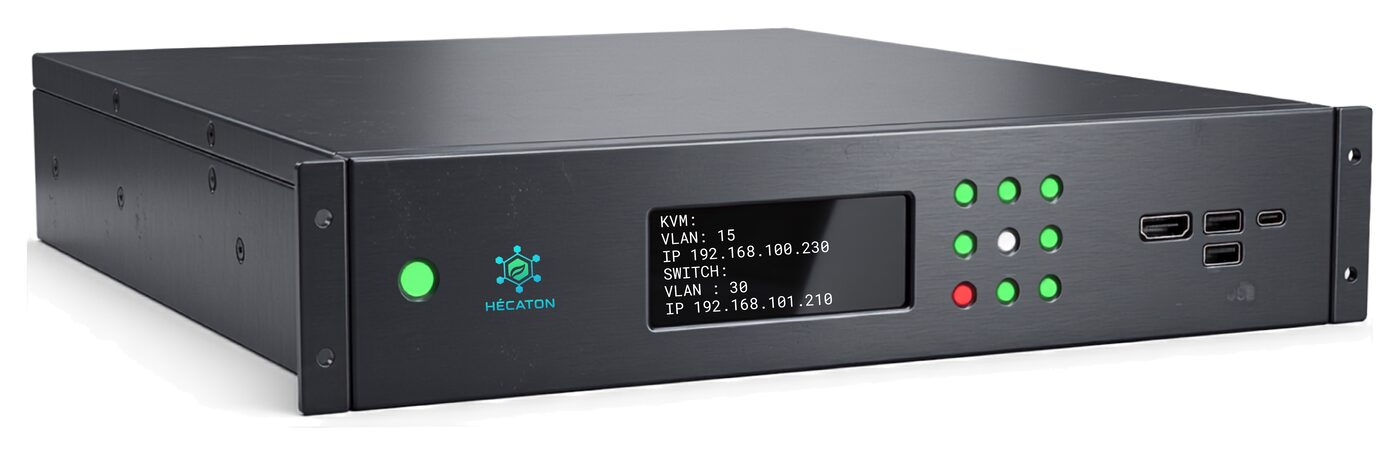
Three-quarter view of the Hécaton cluster: a black two-rack-unit enclosure with mounting ears at the front. On the front panel, a power button, the Hécaton logo, a screen showing the management addresses of the KVM and switch, a grid of nine indicator lights — including a red one for a faulty node and a white one for the node connected to the ports — followed by one HDMI port and three USB ports.
  • Active node
  • Node connected to the screen and ports
  • Faulty node
projected Product concept (prototype under development). 482 mm wide, 600 mm deep — 2 U in a 19-inch rack.

Our purpose

Why we do this

We are building this product to reduce the energy used by computing infrastructure. That purpose drives our work.

Using less energy produces less heat, reducing the need for active cooling and water, which makes it easier to site a data centre in a water-stressed region. Modular hardware can be repaired and upgraded rather than replaced. Assembly takes place in Bédarieux, Hérault, with local subcontractors. You run the system on your own premises, keeping your data and computing on site, even when operating entirely offline.

Is it right for you?

Where Hécaton fits — and where it does not.

  • yes Host your services on your premises Run websites, databases and internal applications in your own server room, as you would in the cloud. Manage them remotely, without going through a third party.
  • yes Local AI An AI model tailored to a particular line of work rarely has more than a few billion parameters. You can run it on your own premises, alongside the services that use it.
  • yes CPU-intensive computing For simulations and processing tasks that cannot be vectorised on a GPU. Nine Apple Silicon nodes give a laboratory or small or medium-sized business substantial computing power, without having to apply for time at a national computing centre.
  • no Memory-intensive computing Our limit is 64 GB per node; an x86 server can offer several terabytes. If your workload needs that much memory, we will say so rather than sell you a system that cannot do the job.
  • yes A rack that runs cool and is easy to service Lower power consumption means less heat to remove. Each node has a light on the front panel, so you can spot a faulty machine without checking the rack from top to bottom or shutting everything down.
  • Different needs? Ask us: we will tell you whether Hécaton fits your needs.

Comparison

How we compare.

x86 servers account for more than 80% of the market. ARM offerings for data centres are aimed at the largest operators, and public cloud has taken the rest. Here is how we compare on each point, including where the alternatives do better.

Comparison of x86 servers, ARM for the largest operators, public cloud and Hécaton
x86 servers ARM for large operators Public cloud Hécaton
Energy efficiencyLowHighLow to mediumHigh
Entry costMedium to highHighLow at first, then risingModerate
ScalabilityA technician must upgrade componentsFixed configurationImmediate, on demandNode by node, without cluster downtime
Maximum RAM Up to 12 TB Up to 1 TB From 1.5 to 12 TB depending on the provider Up to 576 GB
Memory error correctionYesYesYesYes, built into the chip
Control over data and hardwareFullFullDelegated to the providerFull, on site
Control over environmental impact Requires monitoring equipment Requires monitoring equipment Reported by the provider Measured by the cluster planned

Public cloud still has the edge on RAM and immediate scalability. We include both because a comparison is only useful if it gives the full picture.

Pilot customers

Pilot customer programme

Tell us about your workload and the hardware you use today. Your feedback feeds into the design: the interviews we have held so far have already changed what we are building.

Tell us what you need

Stay informed

Follow our progress.

We will publish our measurements as soon as they are reproducible. Give us your email address to be among the first to hear; we will use it only to send you those updates.

Keep me informed Follow on LinkedIn

Our supporters

Working together to go further.

Building a new manufacturing business takes support. These are the organisations that back us or have recognised our work, and how each is involved.

Building the project with us

Research

  • IRIF Institut de recherche en informatique fondamentale, CNRS and Université Paris Cité — predictive management of sleep mode for idle nodes.
  • MSME Laboratoire Modélisation et simulation multi-échelle — thermal characterisation of the enclosure and help with optimising its thermal performance.

Support and funding

Award

  • 101 Femmes Entrepreneures A competition run by the Ministry for Equality between Women and Men and Bpifrance, with the Cap Créa collective. It recognises one winner in each French department, 101 in total. Valeska Valdivia, president and co-founder of Hécaton, is the 2026 winner for Hérault, with support from BGE Ouest-Hérault. Winners can join the Coq Créa ambassador community. Award results: Bpifrance · BGE
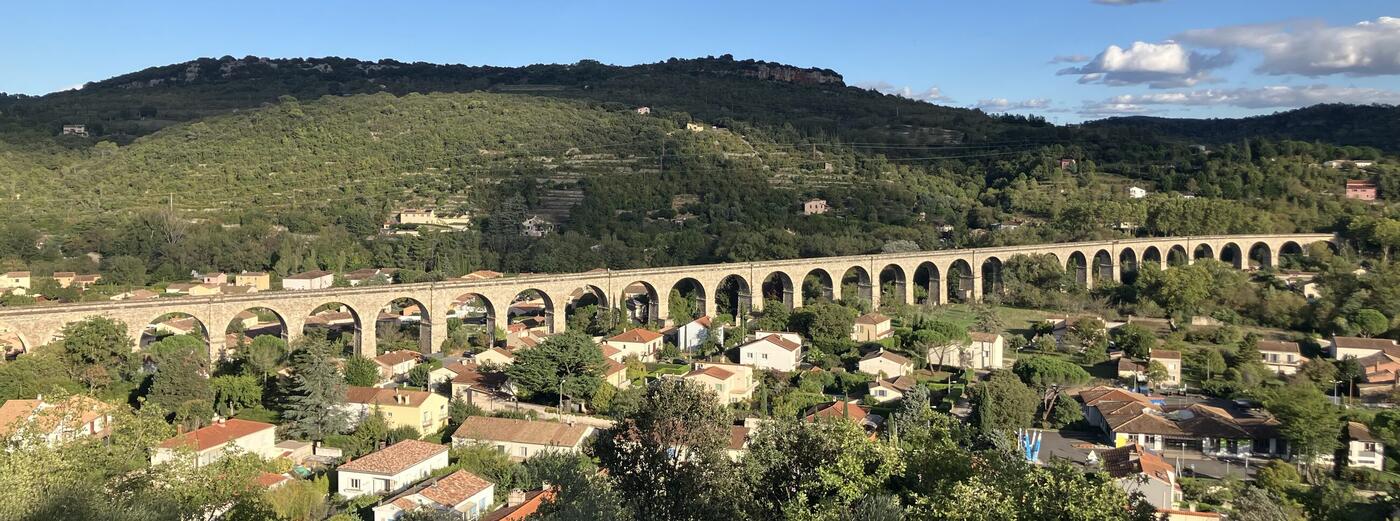
Bédarieux viewed from the surrounding hills: the railway viaduct spans the valley, with the village below and the wooded hills of Haut-Languedoc on the horizon.
Bédarieux and its viaduct, viewed from the surrounding hills. Photograph by Hécaton, September 2024.

Our roots

Designed and assembled in Bédarieux.

Our registered office is in Hérault, in an area designated France Ruralités Revitalisation +. We want to show that a rural area can be home to high-value manufacturing.

Get in touch

Any questions?

Ask us about the hardware, the timetable, or what we can and cannot do yet. Even if it feels too early to ask, please get in touch — that is often when a question is most useful.

contact@hecaton.eu

A real person will read your email and reply.